



Why Does My Dog Eat Poop? – American Kennel Club
AKC is a participant in affiliate advertising programs designed to provide a means for sites to earn advertising fees by advertising and linking to akc.org. If you purchase a product through this article, we may receive a portion of the sale.
Of all the repulsive habits our dogs have—drinking from the toilet, rolling in swamp muck, licking their butts— nothing disgusts most owners more than pondering why dogs eat poop. Their motivation may not be to gross us humans out, but it certainly does. So much so, in fact, that discovering that your dog eats poop is often cited as a reason people try to rehome a dog or even opt for euthanasia.
There’s a scientific name for this poop-eating habit— coprophagia (kop-ruh-fey-jee-uh)—and also both behavioral and physiological reasons why some dogs view poop as a delicacy. If you have a poop eater, don’t despair. There are ways to discourage the habit and even some over-the-counter solutions. Although not deeply probed by science — there are few studies on it — poop eating is a relatively common phenomenon in dogs. In a 2012 study presented at the American Veterinary Society of Animal Behavior annual conference, researchers led by Dr. Benjamin Hart, from the University of California, Davis, found that:
Hart wrote, “Our conclusion is that eating of fresh stools is a reflection of an innate predisposition of ancestral canids living in nature that protects pack members from intestinal parasites present in feces that could occasionally be dropped in the den/rest area.” Translation: It’s in a dog’s DNA to eat poop.
The study consisted of two separate surveys sent to about 3,000 dog owners. While eating poop is repulsive to human sensibilities, it’s not really all that bad from a canine point of view. Dogs evolved as scavengers, eating whatever they found on the ground or in the trash heap, so their ideas of haute cuisine are somewhat different from ours. In his Handbook of Applied Dog Behavior and Training, animal behaviorist Steven R. Lindsay says, that coprophagia “may be one of several appetitive survival behaviors that have evolved to cope with the periodic adversity of starvation.” In other words, when food is scarce, you can’t be picky.
For some species, such as rabbits, eating poop is a totally normal way of obtaining key nutrients. In fact, if you prevent rabbits from doing this, they will develop health problems, and young rabbits will fail to thrive. Fortunately, dogs do not need to get nutrition this way. Poop eating, however, is a normal, natural canine behavior at some life stages.
Mother dogs will lick their puppies to urge them to eliminate, and clean up their poop by eating it, for about the first three weeks after birth. Puppies will also naturally engage in this behavior, eating their own poop (autocoprophagia), poop from other dogs (allocoprophagia), as well as poop from cats and other animals. Some dogs find horse manure and goose droppings particularly appealing. Eating their own poop is harmless, but consuming poop from other animals may cause health problems if the stool is contaminated with parasites, viruses, or toxins. In most cases, this behavior will fade before the puppy is about nine months old.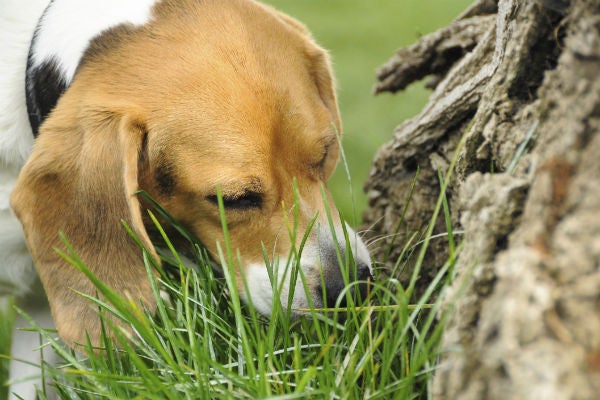
When it occurs in puppies, coprophagia (aka poop eating) is generally considered part of the process of exploring the world around them. Most puppies will be satisfied with a sniff, but a few will want—like human children—to put everything in their mouths, including poop. One bizarre fact: Dogs will rarely eat soft, poorly formed stools or diarrhea. They appear to be attracted mainly to hard stools. Frozen poop, in particular, is gulped down with relish! (There is a reason why dog owners have coined the term “poopsicle.”) In his study, Hart made some other observations about why dogs eat poop:
If your adult dog starts to eat poop, you should consult with your vet to rule out health problems like:
In many cases, dogs start to eat their own poop because of some kind of environmental stress or behavioral triggers, including:
Veterinarians and dog owners have seen improvements in dogs who eat poop with a few strategies, including:
Perhaps the best way to stop the problem is through training and environmental management methods, including:
Need some help training your dog? While you may not be able to attend in-person training classes during COVID-19, we are here to help you virtually through AKC GoodDog! Helpline. This live telephone service connects you with a professional trainer who will offer unlimited, individualized advice on everything from behavioral issues to CGC prep to getting started in dog sports.
AKC is a participant in affiliate advertising programs designed to provide a means for sites to earn advertising fees by advertising and linking to akc.org. If you purchase a product through this article, we may receive a portion of the sale.