



This quote about Putin's machismo from Angela Merkel is just … – Vox.com
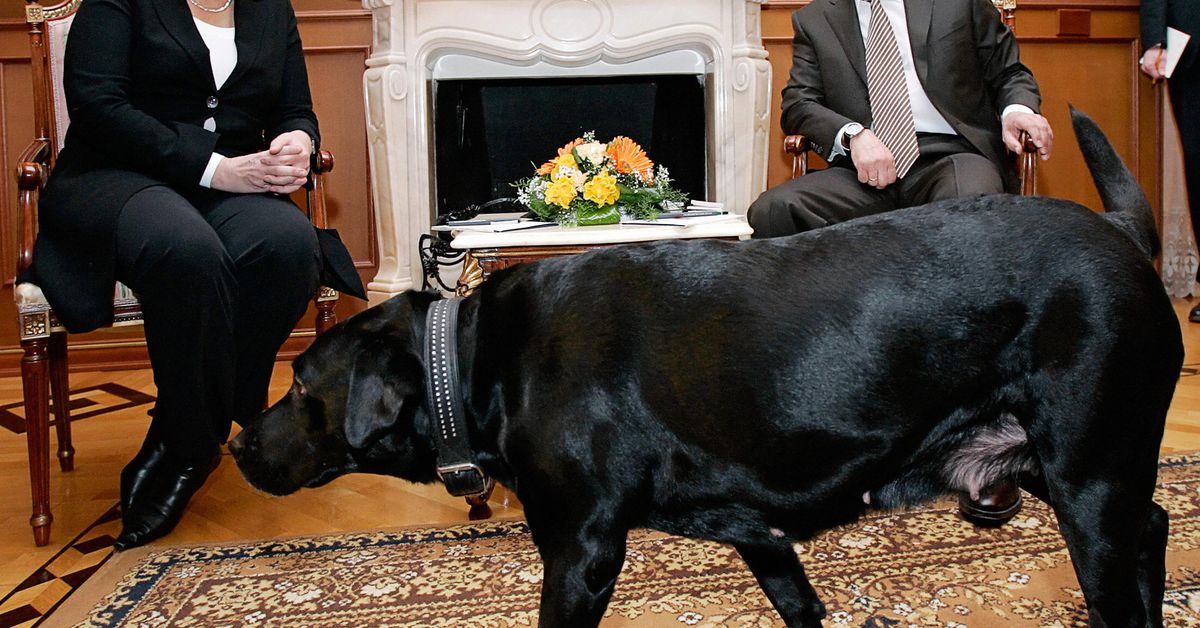
The incident of Vladimir Putin, Angela Merkel, and the dog is a famous one. It was 2007 and Merkel, Germany’s Chancellor, was visiting Putin at his presidential residence in Sochi to discuss energy trade. Putin, surely aware of Merkel’s well-known fear of dogs, waited until the press gathered in the room, then called for his black Labrador to be sent in. The Russian president watched in unconcealed glee as the dog sniffed at Merkel, who sat frozen in fear.
Later, in discussing the incident with a group of reporters, Merkel attempted an explanation of Putin’s behavior. Her quote, reported in George Packer’s December 2014 profile of Merkel in the New Yorker, is one of the most pithily succinct insights into Putin and the psychology of his 14-year reign that I have read:
«I understand why he has to do this — to prove he’s a man,» Merkel said. «He’s afraid of his own weakness. Russia has nothing, no successful politics or economy. All they have is this.»
Merkel is not the first person to suggest that Putin’s machismo — everything from his harassment of fellow heads of state to his shirtless photos to his invasion of Ukraine — are shows of strength meant to mask feelings of weakness. But she has put her finger on this phenomenon with remarkable bluntness.
Merkel, who grew up in Soviet-dominated East Germany, who learned Russian in school and traveled throughout the Soviet Union, has an especially close relationship with Putin (this incident notwithstanding) and unusual insight into how Putin’s Russia works. Among Western leaders, her relationship with Putin is almost certainly the closest and most important. Yet all this closeness has apparently made her respect Putin less, not more.
Putin first took power in 2000, but the nature of his rule changed in 2012, when he won reelection amid public protests and accusations of fraud. Those protests, along with the collapse of Russia’s economy from growth-powerhouse to the edge of recession, have left Putin feeling obviously and correctly insecure about his hold on power. At the same time, in the wake of the cold war Russian leaders and regular citizens have felt increasingly insecure in the America-dominated world. They have a sense that Russia is under siege from without and has been robbed of its rightful status as a world power.
Putin, in shielding his personal insecurity as a weak leader, has also tapped into the larger sense of Russian insecurity. That is part of why his demonstrations of masculinity — though they appear ridiculous to outsiders like Merkel — so resonate among Russians. Like Putin, many Russians see demonstrations of defiance and strength as reassurances against the crushing sense of weakness.
More importantly, Merkel is correct to observe that Putin and Russia are so ready to embrace this superficial machismo because they just don’t have much else to hold on to. It is universally true, in all countries, that economic decline leads to feelings of national insecurity — just look at how often Americans talk about «American decline» since the financial crisis — as well as to more extreme politics, as in much of Europe. But Americans and Western Europeans at least have recourse at the ballot box; they can angrily vote in or out whoever they like.
Russians do not enjoy the luxury of democracy. So Putin, hoping to channel Russians’ feelings of national despair away from rage at their own government, have directed them instead toward feelings of fear and hostility at the West, and toward the useful outlet of macho nationalism.
This has been a huge success for Putin in the short term, but it has mired him in a hostile foreign policy that led him to invade Ukraine, attracting severe Western sanctions that have only further weakened Russia. It is also dangerous, entering the nuclear-armed and legitimately formidable Russian military into a war in Europe. But at least Merkel, who is in many ways the pivot point between Russia and the West, understands what she is up against.
Help us reach our year-end goal
In a recent reader survey, we were delighted to hear that people value Vox because we help them educate themselves and their families, spark their curiosity, explain the moment, and make our work approachable.
We believe that everyone deserves access to clear, factual information that helps them educate themselves on the issues of the day and the things that pique their curiosity. That’s why we’re committed to keeping Vox free.
Reader gifts enable us to offer free articles, videos, and podcasts to everyone, while relying less on advertising. In service of that mission, we’re aiming to add 3,000 new gifts from readers by December 31.Will you help us reach our goal, and continue to keep Vox free, by making a gift today?
$95/year
$120/year
$250/year
We accept credit card, Apple Pay, and Google Pay. You can also contribute via
Each week, we explore unique solutions to some of the world’s biggest problems.
Check your inbox for a welcome email.
Oops. Something went wrong. Please enter a valid email and try again.