



10 Greatest Wrestlers In Lucha Libre History – TheSportster
Lucha Libre has a rich history with loads of tremendous wrestlers, many of which have gained international recognition.
If one were to poll North American pro wrestling fans about the greatest wrestlers of all time, answers would likely include old school legends like Ric Flair and Randy Savage, Attitude Era favorites like Steve Austin and The Rock, and maybe a foundational talent like Lou Thesz for good measure. Some may include Japanese legends, but for some reason it’s easy for many fans to leave out the lucha libre stars of Mexico, Rey Mysterio notwithstanding.
It’s a shame, as lucha libre itself has a rich history with loads of tremendous talents, many of which have gained international recognition and influenced the sport abroad. Let’s take a look at 10 of the greatest luchadores of all time — both masked and non-masked performers — including several that North American fans will surely recognize.
Debuting in 1963, Mil Mascaras ended up becoming an icon of the sport, following in the footsteps of El Santo and Blue Demon by starring in movies and becoming a pop culture institution. He also proved to be an international sensation, having popularized the lucha libre style outside of Mexico, notably with WWE, where he worked with the company to convince the New York State Athletic Commission to allow pro wrestlers to wear masks. While he’s been a source of controversy over the years, Mascaras’ influence cannot be understated.
A staple of long-running Mexican promotion for decades, Negro Casas is one luchador whom fans regularly compare to Ric Flair in terms of longevity as a performer, and still wrestles today while in his 60s. Fans have praised Negro Casas for his remarkably consistent in-ring ability, noting that he’s had great matches with pretty much every lucha libre star of note since he came into prominence in the 1980s. While he’s had great feuds with Mistico and countless others, Negro Casas’ biggest feud was with fellow living legend El Hijo del Santo, with their 1997 apuestas match gaining high praise.
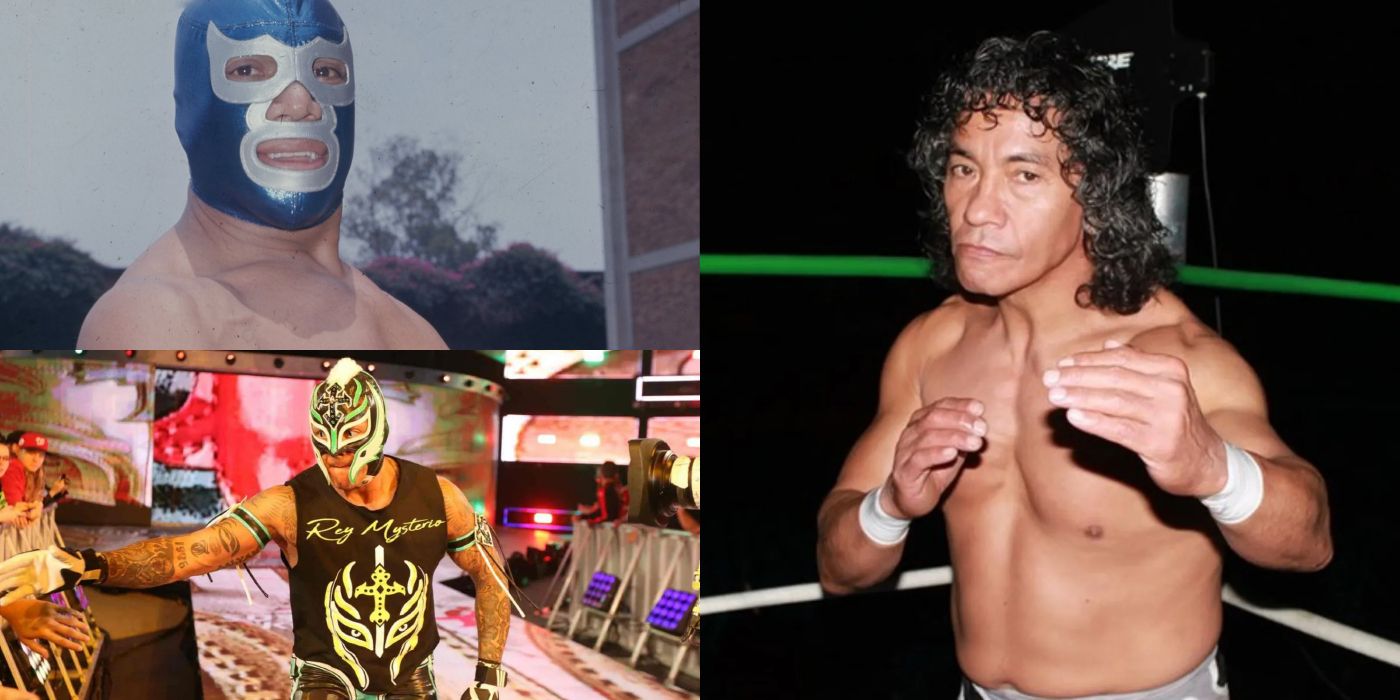
Fans may be familiar with Blue Demon Jr., who’s appeared on WWE programming as well as Lucha Underground, but his adoptive father, the original Blue Demon, is another one of those iconic masked luchadores who starred in a ton of movies, with his blue and silver mask often imitated. Initially a heel, Blue Demon turned babyface after El Santo defeated and unmasked Demon’s tag team partner, Black Shadow, in a landmark match.
Despite his babyface status, Blue Demon would be one of El Santo’s great storied rivals during his career, dethroning the legend for the NWA World Welterweight Championship and enjoying a four-decade career.
The aforementioned Mistico is best known to North American wrestling fans as the original Sin Cara in WWE, who developed a reputation for regularly botching moves as he slid down into the undercard. It’s a real shame, as Mistico was one of Mexico’s biggest draws and CMLL’s top babyface for the five years before signing to WWE, and has since regained the gimmick that made him famous in 2021. A gifted in-ring competitor, Mistico is also ridiculously decorated, having held multiple titles at the same time.
Perro Aguayo is a name that made the news in 2010s, as El Hijo del Perro Aguayo tragically died in the ring in 2015. The elder Aguayo died in 2019, and left behind a tremendous legacy in lucha libre. Performing from the ‘70s to the ‘90s, Perro Aguayo was a huge draw during his time, notably taking on El Santo as the last big feuds in the latter’s career, including a bloody mask vs. hair apuestas match in 1975. In the ring, Aguayo was a hardcore brawler akin to Terry Funk, complete with the willingness to bleed large amounts of blood.
Another non-masked legend, the highly decorated Ray Mendoza was a boxer who retired due to injury only to find even greater success in lucha libre, where he was one of the great rudos (villains) of his era. He also ended up co-founding his own promotion, the Universal Wrestling Association. Internationally, Mendoza was big in North America’s National Wrestling Alliance, becoming the first Mexican to capture the World Light Heavyweight Championship, which he held five times during his career. On top of all that, Ray Mendoza’s five sons followed in his footsteps as the masked Villanos.
El Santo has been referenced several times at this point, and will be covered below. But special consideration needs to go to his son, El Hijo del Santo. To call El Santo an icon feels like an understatement, and pro wrestling is full of second-generation talent that proved to be also-rans, so for El Hijo del Santo to reach anywhere near the heights of his father is a miracle.
By many accounts, El Hijo del Santo is actually considered to be a better in-ring performer than his father, and is moreover considered one of the best Mexican wrestlers of all time, having competed in CMLL, AAA, and even WWE.
North American fans of course know the name Guerrero thanks to Chavo Sr., Eddie, and Chavo Jr., among others. But Chavo Sr. and Eddie’s father, Gory Guerrero, is not only the source of the Guerrero wrestling dynasty, but also one of the greatest of all time. In his heyday, Gory Guerrero was part of a legendary tag team, La Pareja Atomica, with El Santo, and put on a huge match with NWA Champion Lou Thesz in Mexico in 1954. A technically gifted wrestler, Guerrero innovated a number of moves including the Gory Special, the Gory Bomb, and the Camel Clutch.
At this point, Rey Mysterio Jr. — often simply referred to as Rey Mysterio — has spent more time wrestling in North America than he has in Mexico, but he still deserves his GOAT status as far as lucha libre is concerned. Wrestling for AAA in the early to mid-1990s, Mysterio moved on to WCW and later WWE, where he made the high flying cruiserweight style a must-see affair for many fans. Still wrestling today, Mysterio is easily one of the most popular luchadores in the world, and for many is the masked wrestler from Mexico.
It’s finally time to talk about El Santo, one of the most untouchable icons in all of pro wrestling — not just Mexico. Coming into prominence with the gimmick in the 1940s, El Santo’s eventual babyface turn made him ridiculously popular, and his status as a pop culture icon was furthered by his starring roles in myriad films from the 1950s all the way to the early 1980s as he fought huge matches with rivals like fellow legends Blue Demon, Perro Aguayo, and Negro Casas. More than just a pro wrestler, El Santo became a cultural icon and folk hero — the kind that people in Mexico make statues of.
Danny Djeljosevic is a writer based in San Diego, CA. His last name is slightly easier to pronounce than it looks.